

Of course you have a Teddy Bear. Don’t be ashamed to admit that somewhere in your house is that wonderful little bear someone gave you soon after you were born.
Is the bear in the basement in some old box? Or even in the attic? I surely hope not. That bear of yours should be in your bedroom. After all, bears are given to you to comfort you in your childhood: just after Mum or Dad had lectured you on not closing the screen door, or your teacher told your mother you wouldn’t share toys at your kindergarten. And your bear did just that, right? And I am certain your bear is ready at any moment to offer you a little bit of a lift.

Bears come in all shapes and sizes and, indeed, often in colours one would not think a bear bearing (pun intended). There are brown bears, black bears, orange bears, blue bears (but that’s almost sacrilege), and certainly dirty and worn bears. Perhaps the worn bears are the most valued: they could be the most valuable item a person can have. At least to their owners.
Bears certainly have character. Bears can look friendly and seem to smile upon whomsoever gazes on them. They can look grumpy, but no bear is truly grumpy, so it’s just in the beargazer’s eyes that a bear might look grumpy. Bears can look happy. But, because bears have character, bears are not neutral, they are not an ‘it’: no, bears are a he or a she. Did you read that? Bears are either ‘he’ or ‘she’.
Many of you know the story of how Teddy Bears came to be: Margarite Steiff , a German business woman, was stricken with polio early in life, but still got a good education as her friends used to put her in a hay cart and take her to school. Although one of her arms was also affected, she was able to sew and became a tailor, eventually owning her own shop. One day, she made a stuffed elephant as a pin cushion and, subsequently, started giving them to her customers. However, the customers’ children like them so much, as a stuffed toy, they came back for more.
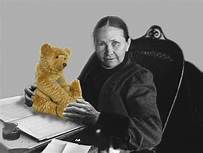
Soon, Steiff started making all sorts of stuffed animals from cats and dogs to pigs, some of them had articulating arms and legs. So, in 1880 the Margarite Steiff MbgH was registered in Germany and her nephew, Richard, joined her in 1887 and became a major figure in the company. He would go to the zoo and make drawings of animals from which stuffed animals evolved.
In 1902, President “Teddy” Roosevelt went on a hunting trip in Mississippi and, after he called other hunters ‘unsportsmanlike’ for jeering him for refusing to shoot a bear they had captured, the event became a cartoon subject in many American newspapers seen by thousands. A shop owner in Brooklyn, Morris Michtom, had a great idea and he and his wife had stuffed bears placed in their shop window, selling them to many people. By permission of President Roosevelt, the Michtoms were allowed to name their bears Teddy Bears and they sold as fast as they could make them, women and children carrying them proudly in the streets. The President himself used one as a mascot in his next re-election bid.
A year later, in 1903, an American gave an order to the Steiff company for three thousand bears, as his adventurous response to the “Teddy” bear craze.
The Steiff company, which is still in operation, has a motto as styled by Margarite Steiff, is “Only the best is good enough for children” and their products are subject to meticulous testing and inspection. They are required to be highly flame resistant and, among other things, smaller pieces such as eyes must be able to resist considerable tension, wear and tear, as only children can give.

In coming up with this post and telling of My Beloved’s and my bears, I realised I would likely become the subject of laughter, perhaps, smirking, or, like President Roosevelt, the object of mockery. No matter, My Beloved and I are proud of our own bears, each of us having kept our bear since they had been given to us some time in or after 1933 . They, as you can see are very well worn, although her Teddy ( right) has withstood the passage of time better than my Teddy. (Just like My Beloved and me.) Nevertheless, they sit by our bedside and represent a lifetime of living together.
Many years ago, before WWII, as I was trying hard to recover from a serious bout of pneumonia, my Nanny taught me to knit. And, of course, the first of several items I knitted was a pair of shorts and a pullover for my Ted. They were around for many a year, but I believe the moths loved them so much while he and I were separated for several years, that when I last saw them, they were nothing but strings of wool around my Teddy. He doesn’t seem to mind not having them, however.
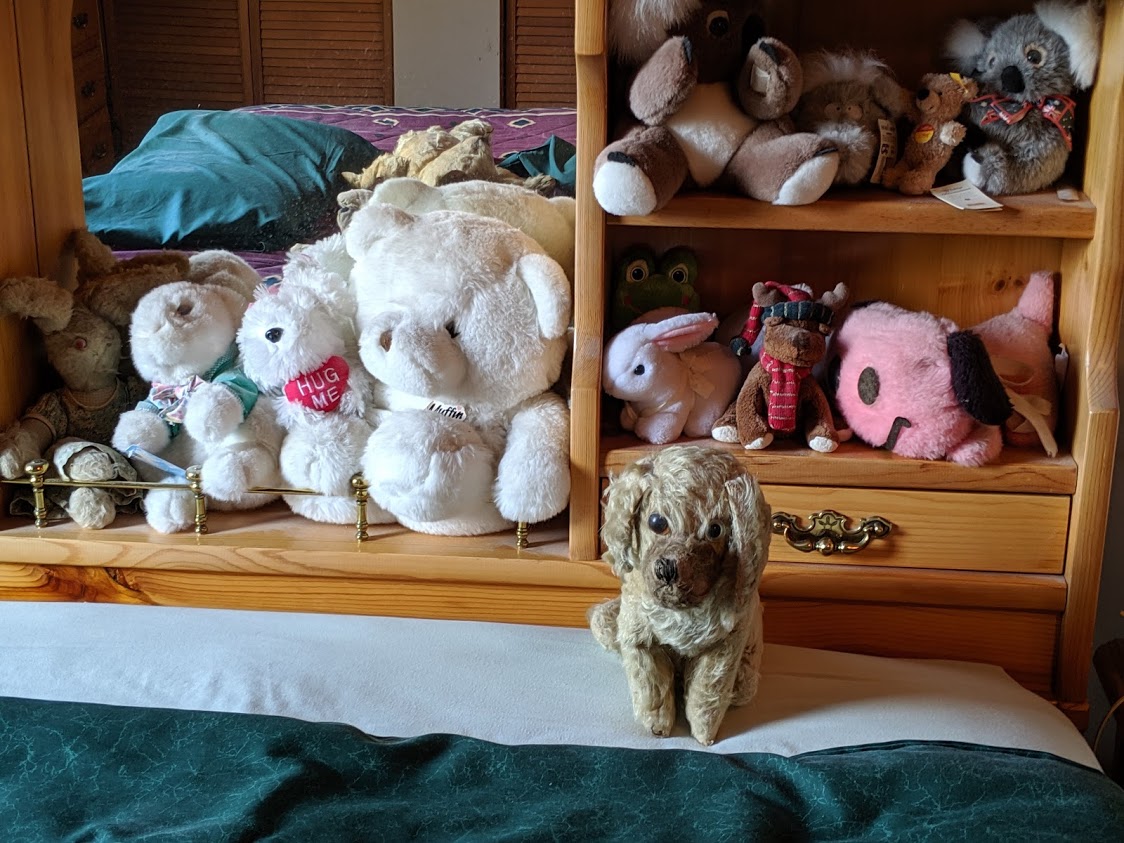
Now, we have many more stuffed friends. In the chair beside our bed, and on the left hand side of the photo above you can see a little piece of Bonzo, my dog. And here is Bonzo, along with a multitude of other stuffed friends. Oh, yes, Bonzo has always been with me, too, but has withstood the passage of time somewhat better than Ted, perhaps because he was a guard dog, sitting there protecting me, whereas Ted was a comforting cuddly friend.
Sometimes I wonder what they do while we are away.
Do they enjoy being left alone for months at a time? Do they have parties? I must say that, particularly when we have guests staying at our house, my wine seems to disappear quite rapidly: could they possibly be doing a little sipping even while we are out on a day trip? And yet, when we return, be it later in the day or several months later, they are all in exactly the same positions as when we left. They really are good at not leaving any evidence of partying. It really is quite likely though they do party, as Pooh Bear has shown over a number of years, that bears can get into mischief.
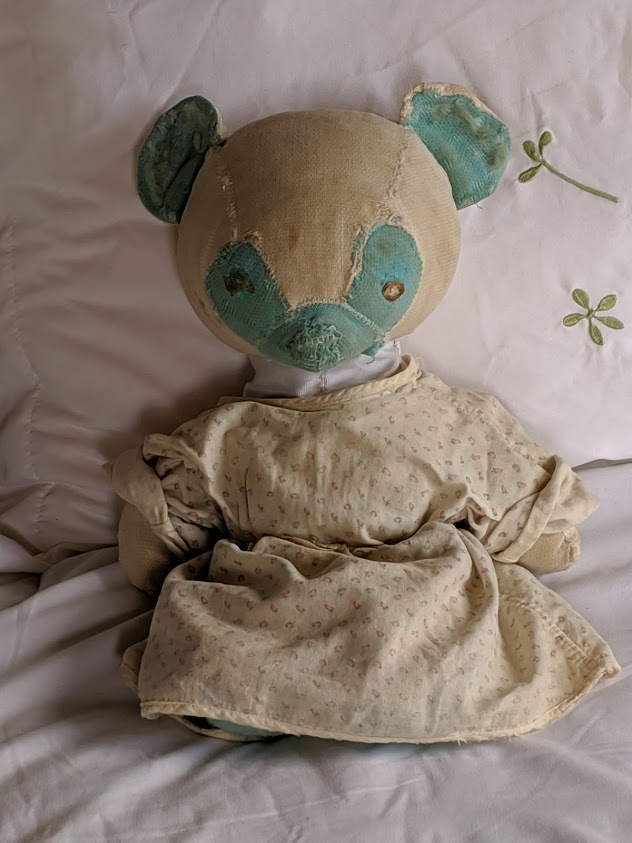
Bears do travel quite well. Although neither of our Teddy Bears does any travelling, there is one bear who has traveled to many places in the world. I cannot reveal which of our children has this fine Teddy, who has been to such places as the UK, Egypt, Israel and several countries in Europe, Barbados, Cayman Islands and all over North America. He has occasionally had to go to the ER, where My Beloved has been able to repair the dire wounds of being stuffed in suitcases and inspected by unimpressed Customs agents. But, as you can see, this very valuable and totally irreplaceable Teddy Bear is a girl bear. You see, I said Teddy Bears can be of either sex, but never, no never, an ‘it‘. However, a Teddy Bear can be androgynous and still be a he or a she.
In an antepenultimate paragraph about Teddy Bears, psychologists say that in today’s society, more so than in previous generations, mother and child are frequently, very often daily, separated, the mother having to go to work. This separation is stressful to the child, so the child looks to something very familiar, her Teddy Bear, with his soft cuddly structure. From infancy, she has had her Teddy Bear and he or she has become part of her life. She has cuddled him, petted him and she has talked and will talk to her Teddy Bear, just as her mother talks to her. Both she and her mother look for ways to smooth over the daily separation; and the Teddy Bear, known to psychologists as a transition object, serves them both well. In fact, the Teddy Bear is almost a magician in making her feel less lonely and separated from her mother.
So, tonight, if, horror of horrors, your Teddy Bear is not at your bedside, go and hunt for him or her and resurrect him or her, then, at dinner, raise a glass of wine – or water, or whatever you drink – to your very own beloved Teddy Bear!
And in a final word, or should I say, image, my Teddy Bear wishes you all the very best for you and knows that your Teddy Bear and he will meet one day in Teddy Bear Heaven, for as sure and as long as Teddy Bears are comforting children, they will all meet and have one gigantic continuous party in that Teddy Bear Heaven!





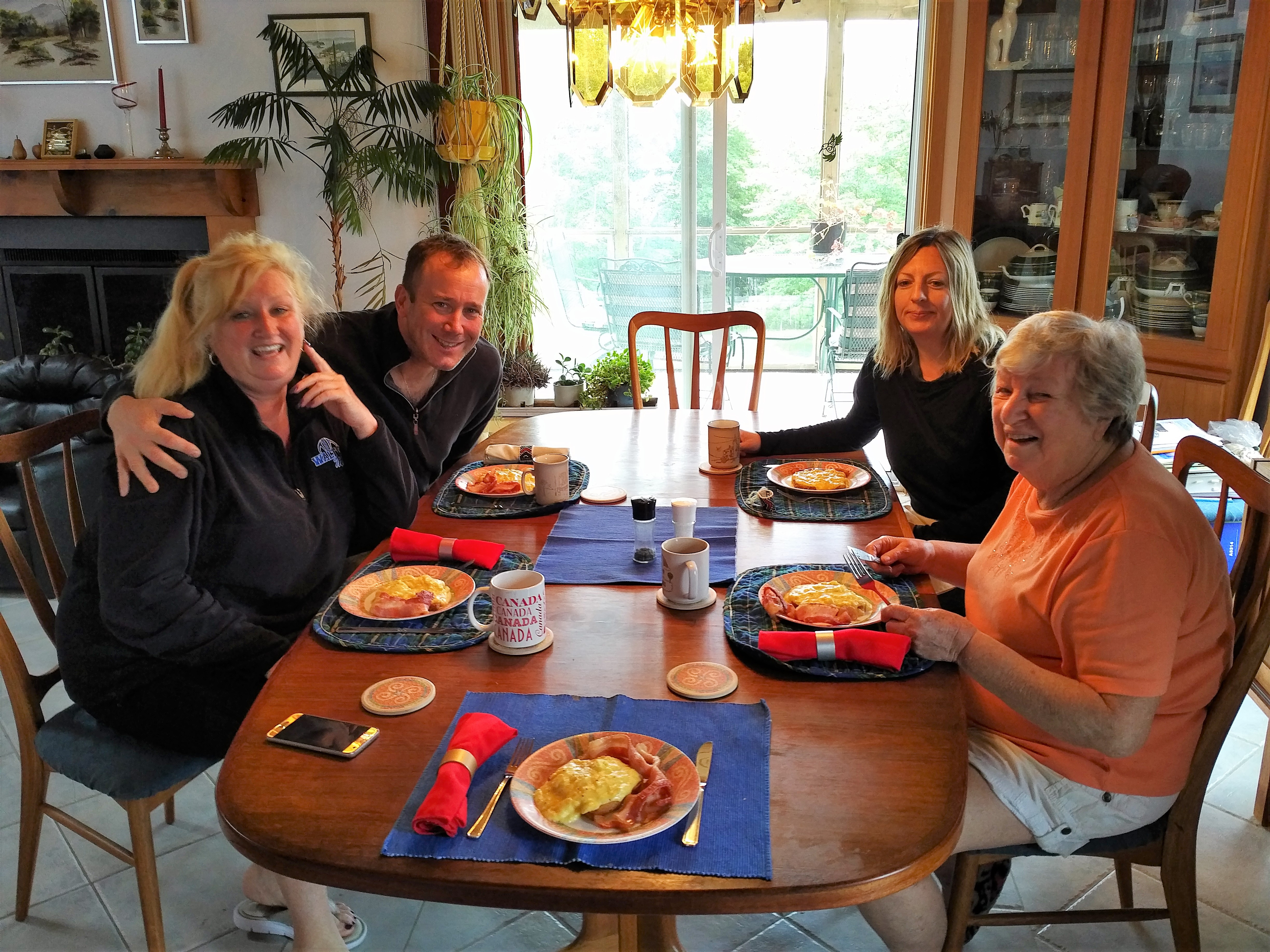
 and her 13-year old son, Jack, come in June every year and stay for all of July, as Jack takes sailing lessons at St. Margaret’s Bay Sailing Club. Last year, the day after their arrival, they were up early,
 Marmite is a delight My Beloved, some of our five kids and I relish. Marmite? Ah, go to the British section of the supermarket. Or World Market in Palm Springs. Yes, it’s a British thing, I’m told, and if you have not been brought up with Marmite, you may not, at a mature age as is Robb, like it. But give it a try – Robb does time and time again: new bread, thickly spread butter and Marmite very lightly spread – you don’t need much. You can also use it in gravies. I think it could be used as a spy test: if you don’t like Marmite, you must be a Russian spy.


 artin Luther King, Jr. on the evening before assassination day, and Letitia Brookes, as Camae, the flirtatious and temptress room-service waitress. They held us spellbound for the entire eighty minutes with lots of humour and leaving us with a vital message that we, as human beings, still have a long way to go to get racial integration.
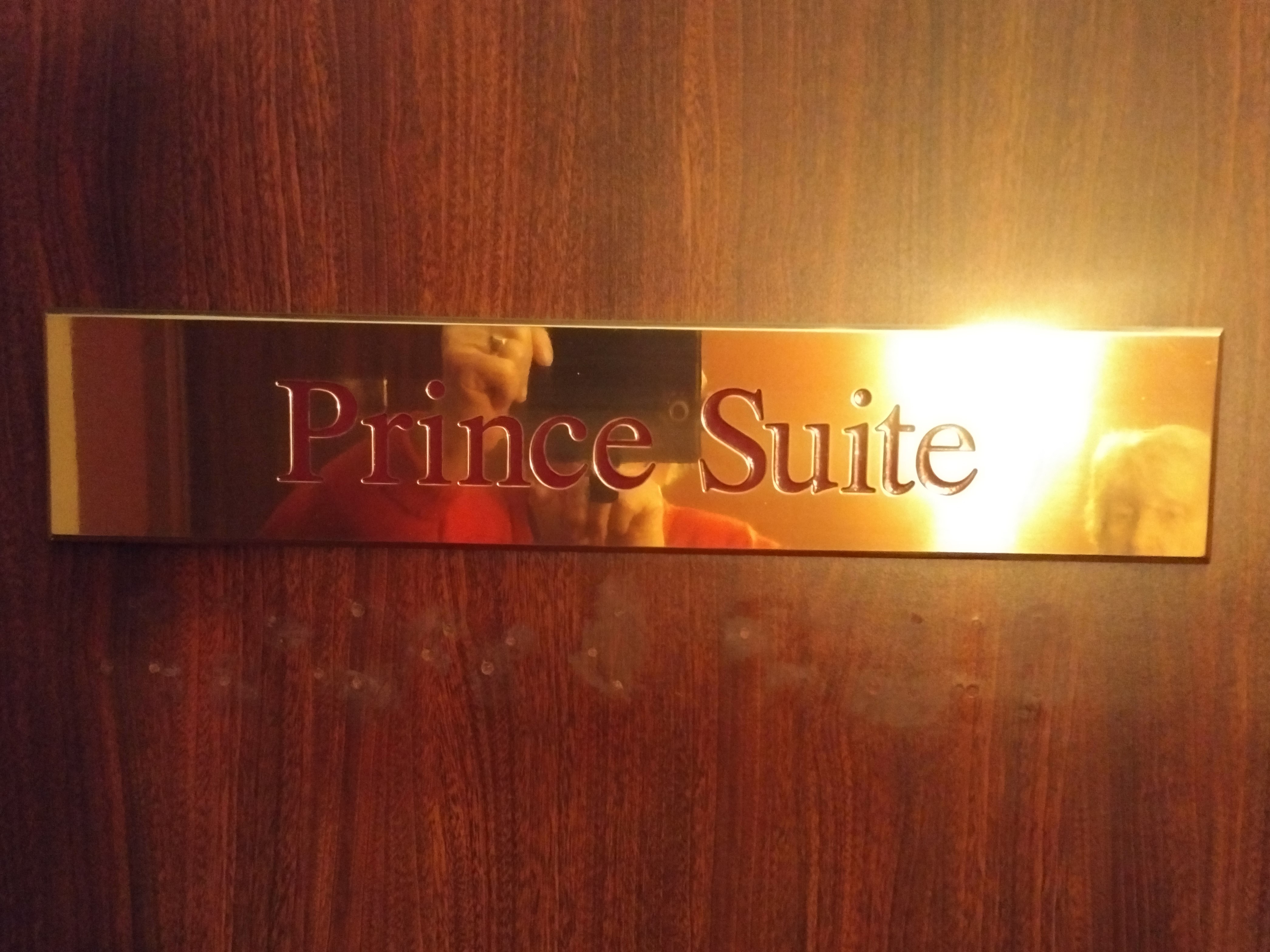 From Neptune, we returned to the Prince George only to discover, in the shortened version of this tale, that Atlanta daughter, Jenny, had found out where we were and had had us upgraded to the most luxurious suite in the hotel, the Prince Suite. Mind, you, I later discovered that she, as only she can, wangled and wrought wonders with the staff to reduce the cost astonishingly. Not that that mattered to us, as she had taken care of the stay and thrown in dinner for us, which My Beloved and I had previously reserved in the very good hotel restaurant, Gio. I had been particularly careful not to tell any of our family and only one friend, and she not until around our check-in time, where we were going to stay and eat. But the wiles of Jennifer Anne are hyperacute. The following day, we walked out with zero on our credit card. Oh, she does something like this every year on our birthdays, for she can do a two-for-one, My Beloved’s birthday being eight days later, tomorrow, in fact. My Beloved and I believe it is wonderful that she is able to do this for us and we are annually very, very grateful.

 Between the appetisers and the mains, Hannah arrived with what I can only describe as a very tasty amuse-guelle in a porcelain Chinese soup spoon. Although Hannah explained what it was, I have no recollection of her description.
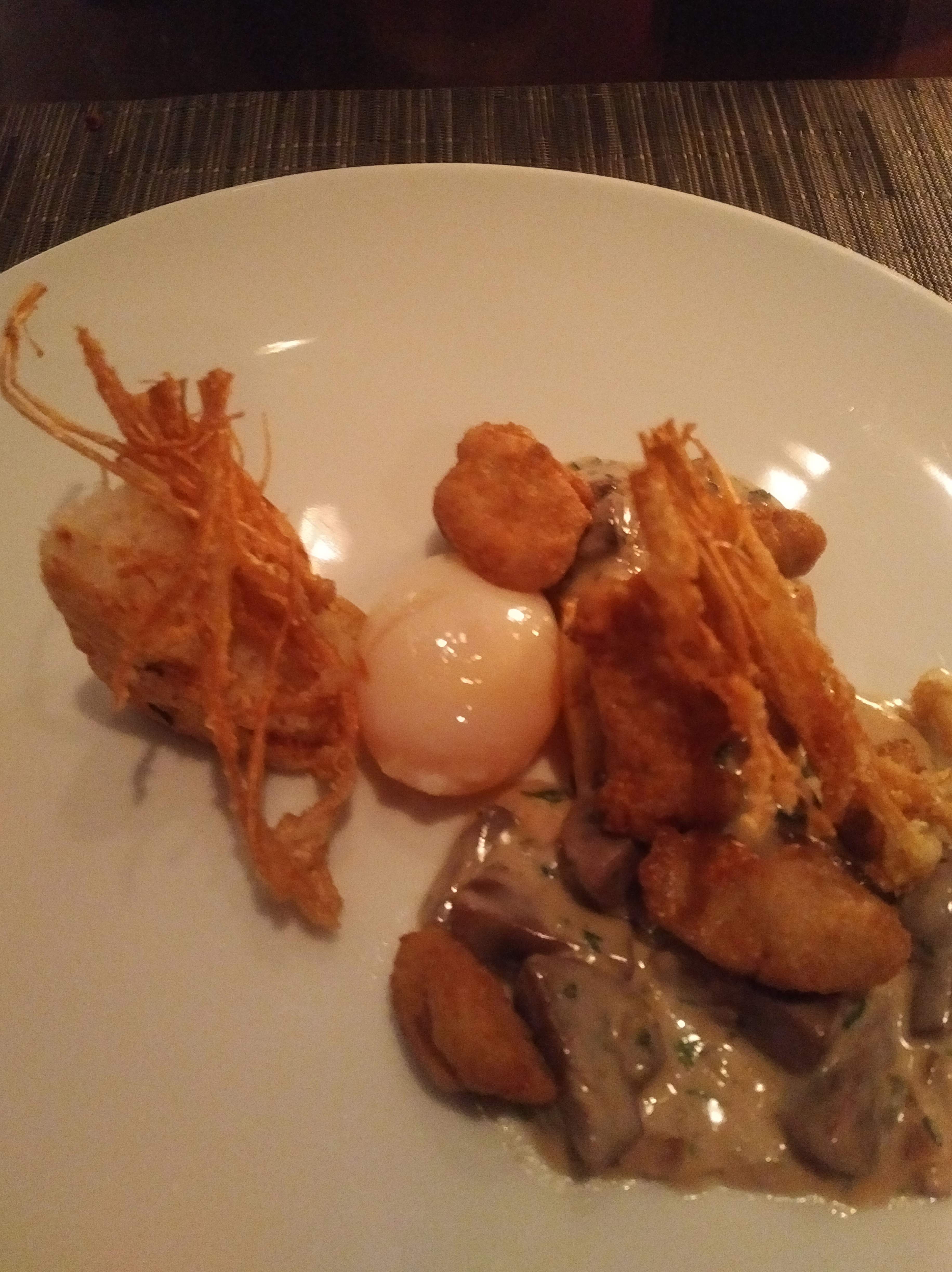 My appetiser was something I had not seen on a menu for years, although it had always been a favourite of mine: sweetbreads. No, that is not a form of sourdough bread; it is – usually – either the thymus or the pancreas of a calf or lamb. Mine were described on the menu as breaded sweet breads, focaccia, mushrooms, pickled egg and tempura enoki mushrooms. Oh, how these sweetbreads brought back so many far-off memories of delicious ones, especially creamed, eaten with my parents during or after the war (WWII, not WWI), as during the war meat was scarce or unobtainable, but you ate every part of an animal. When creamed, they are soft and tender and these at Gio, although soft in the middle, were spoiled a little by the fried breading. Nevertheless, I enjoyed them immensely. I have had them since the war, certainly dining somewhere in North America with My Beloved, but it was a long time ago and neither of us can remember where or when.
 Back to my main, which was three delicious large Digby scallops with rye spätzle, corned beef, chestnuts, kale, brown butter cream, capers, squash purée and crispy sauerkraut. Wow! What an aggregation! But it can be described as par excellence.
 Following this wonderful dinner, we ordered our digestifs, Cointreau on the rocks for My Beloved and a Chocolate Coffee, consisting of kahlúa, bailey’s, crème de cacao, grand marnier and chocolate with whipped cream on top for me, the Birthday Kid.
 behold, a doorbell rang and who should appear but a room service server with a plateful of our favourite Stilton and glasses of Port. Oh, and a few grapes, but who cared about them.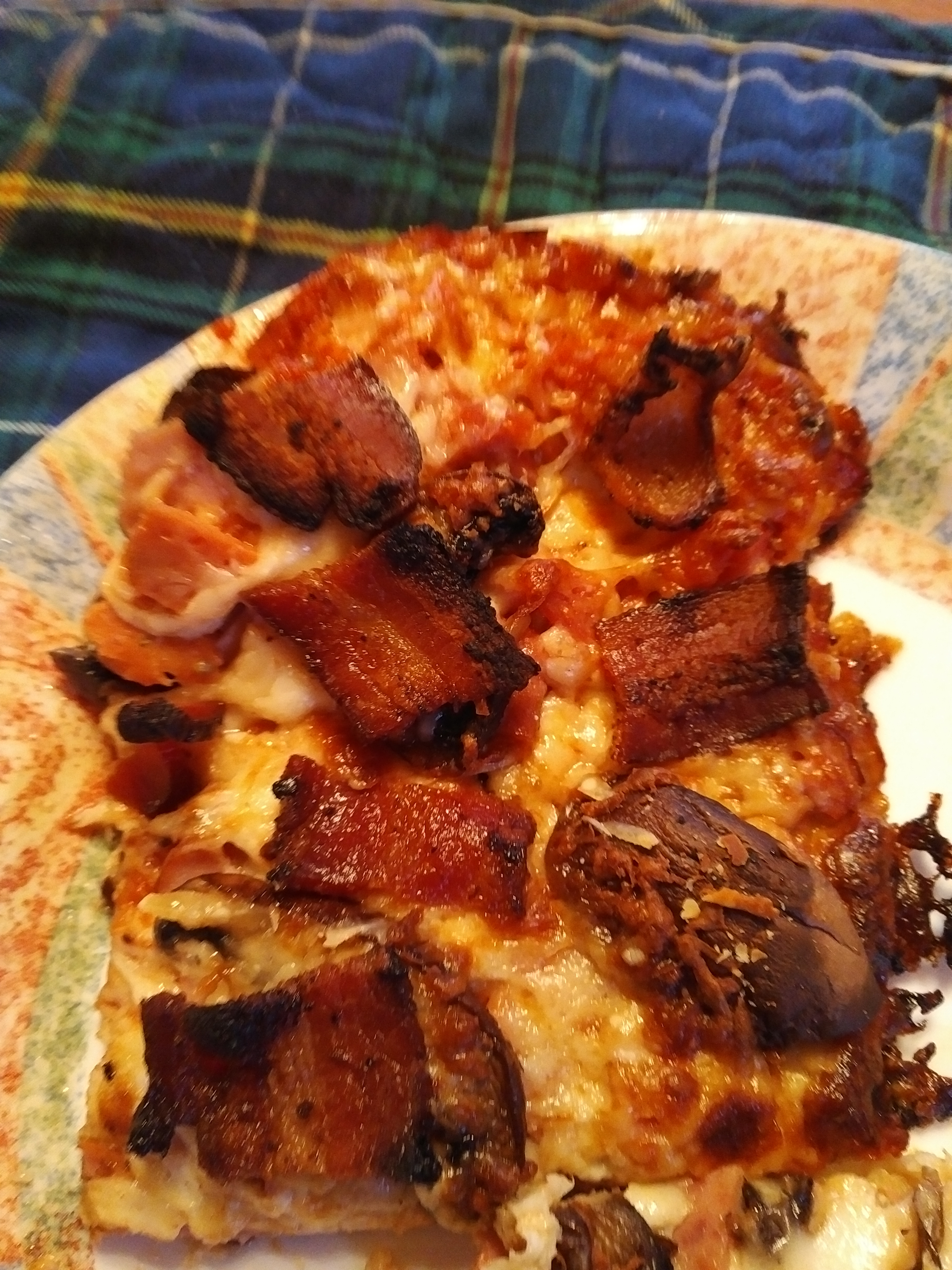
 He fixes that, but the very next day you hear more squeaks, but not from the belt. (Oh, I am now an expert with auto terms and I can say belt, sort of knowing what it is.) So back to Mr Fixer. Oh, he says, that sounds like rotors. Hey, my car is not a helicopter: it doesn’t have any rotors. No, he says, a rotor is the thing in the wheel that the brake pads grab to slow you down.


 From time to time...